Kendall Park
Herbert Kendall's planned community of 1,500 houses went up from 1956 to 1961. Walls from that era carry many coats of paint, and earlier patch work shows as ridges once new compound is feathered next to it.
Popped fasteners, split seams, ceiling stains from the unit upstairs and openings left after a remodel, rebuilt and textured so the repaired spot carries on the surrounding surface, ready for paint.
We note what happened and book the drywall contractor for your area to call back with a price.
Call 7 days, 7am–9pm
A price is settled on the phone first; nothing is opened up before that.
Describe the damage for a quote
Next, the drywall contractor handling your area calls, asks about the damage and prices the repair.
South Brunswick lies in the humid continental climate zone. Summers run warm and damp; winter afternoons average highs of 38 to 43°F. Rainfall holds steady near 4 to 5 inches each month, winter and summer alike. Drywall responds to each of those conditions in its own way, and the pattern of damage usually identifies the cause.
Furnace heat strips moisture from indoor air, and studs and joists shrink slightly across their width. Tape joints part into straight hairlines. Fastener heads rise above the paint. Where the roof is framed with trusses, a ceiling can pull up and away from a partition wall, opening a crack along the corner that tends to close again by early summer.
Thaw water and long spells of rain load up foundations, window flashing and roof edges. A finished basement usually shows it first: a stain line at low height on the board, or baseboard that has begun to swell.
Damp air puts moisture back into the framing. Winter cracks can narrow, which is why seam cracks get new tape, not caulk or a single smear of compound.
Nor'easters can bring flooding across the Northeast. Rain blown sideways for hours gets past window trim, vents and skylights, and the resulting stain can appear on a ceiling well away from the entry point.
The season-by-season guide to weather damage covers each of these at more length.
Drywall work has no flat rate. Each quote comes from a handful of plain factors, and knowing them in advance makes the damage easier to describe on a call or in a text.
Requests usually fit one of these four headings. Holes, dents and crushed corners are handled as well, often alongside one of them. The path a request takes, from the opening call through to primer, is set out on the page describing how this business works.
Fastener heads showing through paint, taped joints splitting into hairlines, and the January crack along the ceiling line.
Tan water marks, spongy patches and bellied ceilings from a tub, a roof valley or the unit upstairs, opened up and rebuilt once dry.
Access squares, moved switch boxes and cabinet outlines closed flush and given the room's existing finish.
Board that drank water from a wet slab, removed above the stain line and replaced after the framing dries.
ACS figures for 2020–2024 give the Monmouth Junction CDP 3,536 homes. The 1990s account for 1,313 of the homes standing today and the 1980s for 805, so close to six in ten come from those two decades. The 2010s add 476 more.
Houses from that period share three typical drywall faults. None of them signals a failing structure.
Studs go on drying after the walls are boarded. As the wood narrows, a nail that once sat flush is left proud and lifts a small round blister of paint. The standard remedy is a drywall screw beside the old nail, the old nail sunk or pulled, and two or three skim coats over both.
Joints above doors, beside stairs and at the line between an addition and the older rooms take the most movement. A sound repair strips loose tape, beds new tape and feathers the joint wide instead of packing the crack.
In January a truss's top chord sits in cold attic air while its lower chord stays warm under insulation. That imbalance can arch the truss and draw the ceiling up off a partition wall. New tape on its own generally splits again the next winter. The longer-lasting options free the ceiling edge from the nearest trusses or cover the corner with molding nailed only into the ceiling.
The page on nail pop and seam crack repair goes further into fastener and joint work.
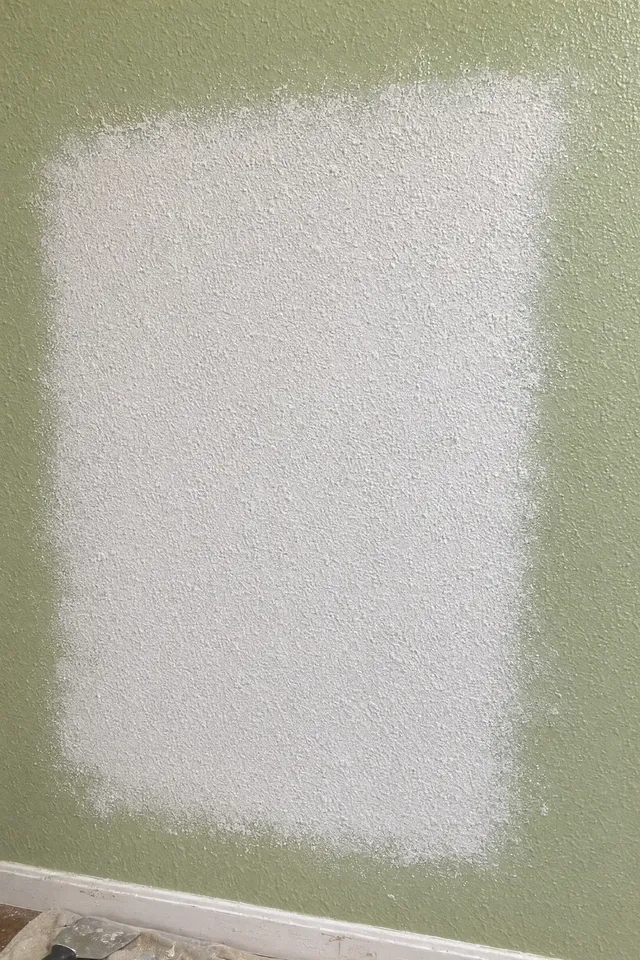
A repair can be dead flat and still stand out after painting. The effect is called flashing. Raw joint compound drinks in the first coat of paint unevenly compared with painted board, so the repaired spot cures to its own sheen.
Drywall primer seals the compound so the topcoat lands on one uniform surface. A missed primer coat explains most patches that show up again under low, raking light.
Flat ceiling white forgives small differences. Eggshell and satin do not, and touch-up paint on a satin wall frequently has to be rolled out to the closest inside corner.
On a textured wall the same pattern is sprayed or built up by hand, then left to set before primer goes on. The drawn samples below show five usual finishes.
Some owners prefer the repair left primed so they can paint it themselves; others want it painted. State the preference when asking for the price, and keep the leftover paint can or its color code if it still exists.
Of the 3,478 occupied homes counted in Monmouth Junction, 1,247 are rented, slightly more than a third. Buildings of five or more units hold another 1,214 homes. For owners and managers of those units, a few habits make turnover repairs simpler.
Three approaches handle nearly all damage. Choosing between them comes down to how big the damaged patch is, whether the board behind it is still sound, and how many small marks are involved.
| Criterion | Backed patch | New sheet | Skim coat |
|---|---|---|---|
| Best for | One hole or opening up to about a foot | Large, wet or crumbling areas | Many small dings, torn paper or uneven walls |
| Board removed | Only the damaged square | Whole bad section, down to studs or joists | None |
| Compound coats | Usually three | Three over every new joint | Two or more over the whole surface |
| Texture work | Blended over a small area | Rebuilt over a wider area | Whole wall or ceiling |
| Disturbance | Low | Highest: more dust and drying | Moderate: the whole wall is coated |
Monmouth Junction is not a municipality of its own. It is an unincorporated part of South Brunswick Township in Middlesex County, tracked by the Census Bureau as a CDP. Heathcote sits on its northwest side, Deans on its northeast and Dayton on its east, all in the same township; Plainsboro Township adjoins it to the southwest.
Repairs are arranged in each of those places and slightly beyond: Kendall Park and Kingston within South Brunswick, North Brunswick to the northeast, and Princeton Junction on the far bank of the Millstone from Plainsboro. A town-by-town page for the whole coverage area adds a line or two on each.
Herbert Kendall's planned community of 1,500 houses went up from 1956 to 1961. Walls from that era carry many coats of paint, and earlier patch work shows as ridges once new compound is feathered next to it.
The census counts 845 attached houses in the CDP. Units joined by party walls and stacked ceilings can pass water sideways and down, so a stain is traced back before any board is opened.
Kingston falls within five historic districts along the Millstone River. Older houses there may be plaster rather than gypsum board, which changes how cracks are opened and filled.
The old Walker-Gordon dairy farm was redeveloped as 350 detached houses. Newer framing like this commonly shows popped nails and truss lift once the furnace has run through a winter or two.
Popped nails, dings, anchor holes and openings no bigger than a fist. Compound goes over a reset fastener or a small backed patch in a couple of thin passes, and texture is touched in over a small spot. Drying usually splits the work into two short sessions.
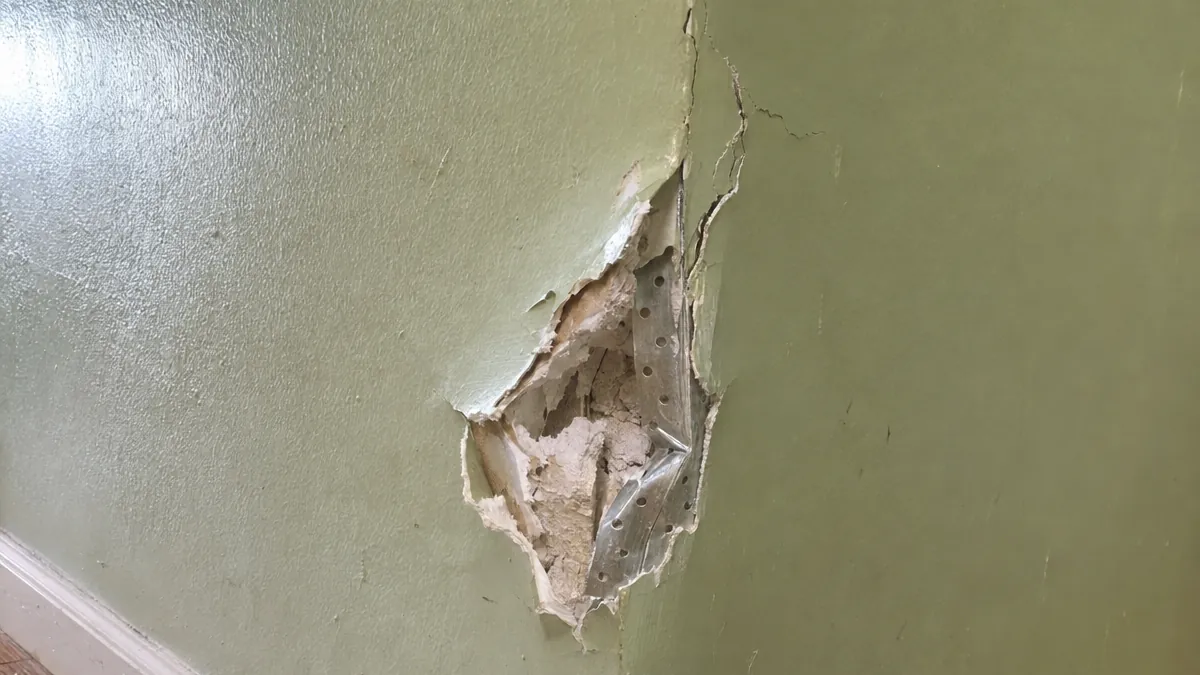
Doorknob holes, a crushed outside corner, a split seam a few feet long, or a stained square of ceiling. The bad board is squared off, backed, replaced and taped. Three coats are normal, then texture and primer; the calendar runs to two or three working days.
A water-damaged ceiling bay, the lower band of a basement wall, or several openings from a remodel. Board is stripped to solid material and framing, the wood is tested for moisture, new sheets are hung and each joint is taped. Texture and paint span a wider area, and the job runs over several days.
A few lines and one picture are plenty to begin. Name the room, estimate how big the damage is, and say whether whatever caused it has been stopped.
Whatever you send goes on to the drywall contractor for your part of town, who calls to discuss the damage and give a price.